A District's Guide to Meeting Personal Finance Education: Meeting the Mandate, Mastering the Outcome
As financial education becomes the law in most of the country, the open question is no longer whether students will take the course. It is whether they will actually learn from it.
The policy momentum behind financial education is now undeniable. According to the Council for Economic Education's 2026 Survey of the States, 39 states require students to take a personal finance course to graduate, up from 35 just two years earlier, with California, Delaware, Colorado, and Hawaii among the most recent to adopt a semester-long requirement. CEE estimates that, as these laws take effect, more than 13 million students will have access to a financial education course. The National Association of State Boards of Education puts the count even higher, reporting that 41 states now require personal finance education for graduation, in some form. Nearly every state has also incorporated personal finance into its K-12 academic standards, and in 2021, CEE and the Jump$tart Coalition for Personal Financial Literacy jointly published the National Standards for Personal Financial Education, giving the field a single, shared definition of what students should know.
A mandate, however, is a legal obligation, not an instructional outcome. It tells a district that it must teach personal finance; it says nothing about whether students will retain what they learn. And there is a real reason to worry that the requirement alone is not moving the needle. Even as mandates have spread, U.S. high schoolers averaged just 64% on the National Financial Educators Council's 2025 National Financial Literacy Test, down from 66.2% the year before, and American 15-year-olds have scored roughly average and essentially flat on the financial literacy portion of the OECD's PISA assessment over the past decade. The course is increasingly required. The learning is not yet guaranteed.
This is the gap Intertwined was built to close, and it has two halves. Districts fall short on compliance when the cost or staffing burden of a new course is more than they can carry, a problem concentrated in exactly the under-resourced schools the mandate is meant to help. And even districts that comply often fall short on learning, because the standard tool for satisfying a requirement, a textbook or a slide deck, produces recall that fades long before a student ever signs a lease or opens a brokerage account. Intertwined makes compliance free, so cost is never the reason a student goes without, and it is built around simulation and game-based learning because that is what the evidence actually shows drives outcomes. Of the 39 states that now require personal finance, 27 use Intertwined, and the platform currently reaches more than 50,000 students across 230-plus districts in 33 states.
Part I: Compliance should not depend on a budget line
The first barrier to teaching personal finance is rarely conviction. It is capacity. A small rural district or an under-funded urban school may be required to offer the course while having no staff member trained to teach it, no curriculum to hand them, and no line item to buy one. This is not a marginal concern: research cited by CEE and others has consistently found that when a personal finance course is optional, students in less affluent areas are the least likely to receive it. The mandate lands hardest precisely where the resources to meet it are thinnest.
Intertwined's answer is a permanently free Starter tier. Any teacher, in any school, can create an account at no cost. The free tier includes the teaching toolkit, pacing guides, lesson plans, lecture slides, worksheets, and case studies, all aligned to the national standards that most state requirements are built on, along with game-based content through the Arcade and its library of 15-plus games, financial calculators, and a glossary. There is no trial window and no expiration. The paid tiers add the deeper interactive layer, the decision-making simulators described below. With the free tier alone, a teacher with no finance background and no budget can stand up a compliant, standards-aligned personal finance unit on the first day of class without a purchase order. As Clippert Connin, an Indiana personal finance teacher, describes it, the curriculum "covers the required material to meet state standards," and "doesn't need add-on material if you are teaching a one-semester class."
For districts that want the full platform but cannot fund it, there is a second, deliberately non-philanthropic path. Under the Community Reinvestment Act, banks are obligated to invest in the communities they serve, and financial education in local schools is a qualifying activity. Old National Bank and First Merchants Corporation have both sponsored schools through Intertwined, covering the cost so the district pays nothing while the bank documents genuine community impact. The result is the same from the student's seat: full access, at no cost to the school.
It is worth understanding why that path exists, because it is older and sturdier than most people realize. Congress passed the Community Reinvestment Act in 1977, enacted as part of that year's Housing and Community Development Act and signed into law by President Carter, to confront redlining: the practice, traceable to federal "residential security maps" drawn in the 1930s, of denying credit and investment to neighborhoods deemed risky, which in practice meant low-income and minority communities. The law's premise was straightforward. Because banks enjoy public benefits such as federal deposit insurance, they carry a corresponding obligation to help meet the credit and development needs of the entire community they serve, including its low- and moderate-income areas. Three federal regulators, the Federal Reserve, the Office of the Comptroller of the Currency, and the Federal Deposit Insurance Corporation, examine banks on that record and assign public ratings that factor into approvals for new branches, mergers, and acquisitions.
Financial education is among the activities the CRA recognizes. Community development services that build financial capability in low- and moderate-income communities have long counted toward a bank's record, and the regulators' 2023 modernization of the rule established a clearer, published list of activities that qualify for CRA consideration. A bank that funds a school's Intertwined license is supporting a recognized form of community development: putting financial knowledge into the hands of students in its service area who have historically had the least access to it. Because Intertwined captures engagement and outcome data at the school and district level, a sponsoring bank also has documentation of the activity's reach to share with its examiners.
One point matters for any district considering this route: the bank relationship belongs to the school. Old National Bank and First Merchants Corporation are examples of how this has worked, but in each case it is the district, not Intertwined, that secures the sponsor, because the bank is investing in its own local community and its own CRA standing. Intertwined can support that process: we can help schools identify banks with a likely CRA interest in their area, frame the opportunity in the terms a bank's community-development team uses, and provide the engagement and outcomes data a bank needs to report the sponsorship. The relationship stays with the district.
The design principle behind the free tier is simple: in a system that has made this education compulsory, cost should not be the barrier that keeps it from students.
Part II: Why "covered" is not the same as "learned"
Removing the cost barrier gets a course onto the schedule. It does not, by itself, change what happens once class begins, and this is where most financial literacy instruction quietly underdelivers.
The default model treats personal finance as a body of facts to be transmitted: read a chapter on budgeting, watch a lecture on markets, take a quiz, move on. The trouble is that financial competence is not primarily declarative knowledge. It is judgment, the procedural ability to weigh a tradeoff and live with its consequences, and decades of research on active and experiential learning point to the same conclusion: skills of that kind are built by doing, not by being told. The point is not academic. In the financial education literature specifically, Kaiser and Menkhoff found that active-learning approaches, those that put students into decisions rather than lectures, produced stronger effects on financial behavior than passive instruction.
It is worth being precise about what traditional financial education actually achieves, because that is the benchmark Intertwined should be measured against. The most rigorous evidence we have comes from Kaiser, Lusardi, Menkhoff, and Urban's 2022 meta-analysis in the Journal of Financial Economics, which pooled 76 randomized experiments covering more than 160,000 people across 33 countries. Its conclusion is genuinely encouraging: financial education works, with positive causal effects on both knowledge and behavior, and effects at least three times larger than earlier research had estimated. But "works" is not the same as "transforms." A companion meta-analysis of school-based programs found that the average effect on financial knowledge was about a third of a standard deviation, real and meaningful, comparable to good interventions in math, but modest in absolute terms. That is consistent with what classroom studies find. When Walstad, Rebeck, and MacDonald evaluated a widely used high school personal finance curriculum, Financing Your Future, with pre- and post-tests, students' knowledge scores rose by about 19.7 percentage points, a solid gain, though researchers caution that pre/post results without a comparison group can overstate true learning. And even that still leaves students short of mastery: teenagers continue to average in the low-to-mid 60s on national financial literacy assessments even as more of them complete the required course. Conventional instruction moves comprehension; it rarely transforms it.
Intertwined is designed to do better than incremental, and it does it by changing the instruction, not just the delivery. The platform is simulation-first. Rather than read about budgeting, a student manages a household budget and absorbs the shock of an unplanned car repair throwing off the month. Rather than sit through a unit on markets, they trade in the Stock Market Simulator, raise capital and make payroll in the Business Startup Simulator, and adjust interest rates and taxes in the Economy Simulator to watch the downstream effects unfold. Every simulation puts the student inside a decision they have to own, and the consequence does the teaching. Game-based design, delivered through the Arcade, sustains engagement a textbook cannot, and it is worth noting that this game-based layer ships in the free tier; the simulators extend the same learning-by-doing principle into the deeper, paid decision-making environments. AI personalization meets a struggling student differently than an advanced one, so the same platform can stretch the strongest learner without losing the one who came in behind.
Part III: The evidence, against the right benchmark
The strongest test of an instructional model is whether it works in places that share almost nothing demographically, and whether it outperforms the conventional approach when it does. Two district case studies, deliberately chosen for their contrast, show what the simulation-first model produces.
A Title I school in Chicago. This is a high-poverty urban school: 62.5% of students qualify for free and reduced lunch, and the student body is 76.5% Black or African American and 18.9% Hispanic or Latino. Over the engagement period, students completed 3,570 lessons and 434 quizzes. Average quiz accuracy rose from 50% before using Intertwined to 86% after, a 36-point gain in measured understanding among the students least likely to have had access to this education at all.
A rural Indiana district. Demographically, this district is close to the opposite of the Chicago school: predominantly white, with roughly a quarter of students on free and reduced lunch. Yet the pattern holds. Students there completed more than 24,000 lessons and over 3,000 quizzes, logged nearly 2,900 trades in the Stock Market Simulator, and posted an overall quiz accuracy of 86.2%. Their average accuracy climbed from 67.8% before Intertwined to 93.6% after, an increase of 25.8 percentage points.
It helps to set those numbers in the wider landscape, and to start with a principle: financial literacy is a shared goal, not a zero-sum contest. The country needs more good financial education, not less, and several strong programs have moved this field forward. They also reflect genuinely different philosophies of teaching and learning, from Next Gen Personal Finance's free, teacher-built lessons, to EVERFI's self-paced digital modules, to Ramsey's behavior-first video curriculum, to PersonalFinanceLab's budgeting and investing games. The right fit depends on a teacher's students, their classroom, and their own style, and Intertwined would rather strengthen that ecosystem than claim to replace it.
Program / Study | Year | Evidence Type | Pre | Result | Notes |
|---|---|---|---|---|---|
Intertwined | 2025-26 | Measured (production data) | ~50% | 84.3% | Nationwide average accuracy; AI, simulation-first platform |
Keys to Financial Success (Asarta) | 2014 | Peer-reviewed | 46.85% * | ~72.2% | +25.3 pt gain applied to baseline |
Banzai | est. from site | ESSA Tier IV (rationale) | 46.85% * | ~71.7% | 24.8-pt avg reconstructed from site histogram; units unspecified |
NGPF: FLPEA Results | 2024-25 | Measured, same-instrument | 46.85% | 69.29% | Curriculum/worksheet model (≈ Intertwined free tier) |
Ramsey: Foundations in Personal Finance | 2017-21 | Vendor self-report (1M+ students) | 46.85% * | ~68.9% | +22 pt gain applied |
EVERFI: MassMutual Study | 2023-24 | Confidence metric | — | 67.8% † | +21% more confident, durable 6 months; not a knowledge score |
Financing Your Future (Walstad) | 2010 | Peer-reviewed, control | 46.85% * | ~66.6% | +19.7 pt gain applied |
12th-grade Econ Course | 2019 | Peer-reviewed | 46.85% * | ~60.3% | +13.4 pt gain applied |
FFFL (Harter & Harter) | 2009 | Peer-reviewed, control | 46.85% * | ~55.9% | +9.1 pt gain applied |
PersonalFinanceLab | 2025 | Relative improvement | — | — | +31% to 62% relative by topic; not plotted |
What these programs share is the goal; what they do not share is a single yardstick. Ramsey reports that its students' pre- and post-test scores rose an average of 22 percentage points across more than a million learners. EVERFI, in a 2025 study with the MassMutual Foundation, found that students who completed multiple financial-education courses became 21% more confident in their financial skills, with growth still evident six months later. PersonalFinanceLab reports relative knowledge improvements of roughly 31% to 62% across savings, credit, and investing. Banzai, certified at ESSA's entry evidence tier (Tier IV, which recognizes a research-based rationale rather than a measured outcome), publishes a distribution of student improvement that averages roughly 25 percentage points. And independent academic evaluations of established high school curricula report pretest-to-posttest gains of roughly 9 to 25 percentage points, among them about 19.7 points for Financing Your Future and 25.3 for Keys to Financial Success. Each of these is real evidence that teaching this subject works.
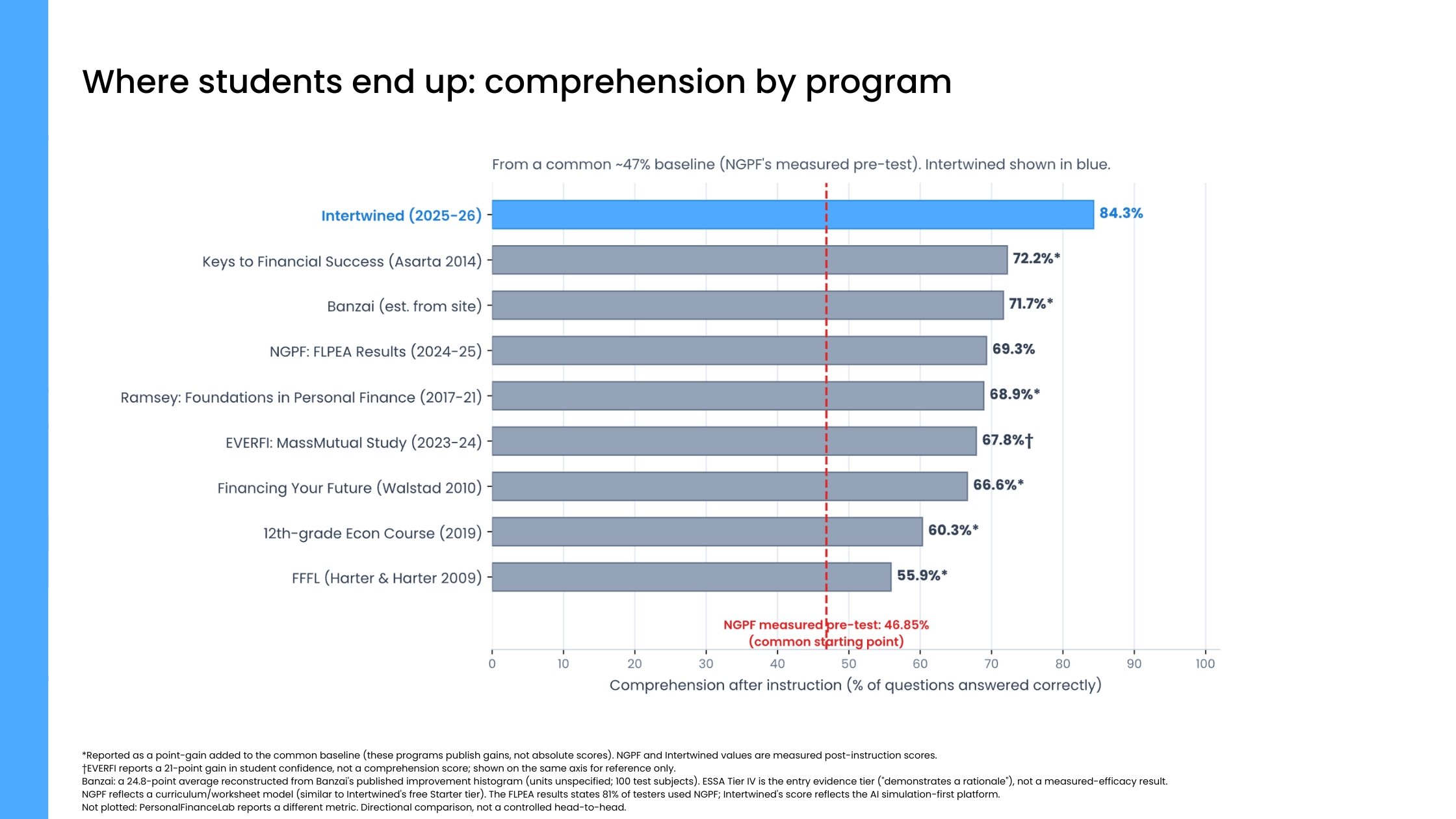
The cleanest comparison comes from Next Gen Personal Finance, which publishes national pre- and post-test results from the Financial Literacy Progress and Efficacy Assessment it runs with Penn State Behrend, an unusually transparent, same-instrument design. Across that assessment, students moved from 46.85% before instruction to 69.29% after, a 22-point gain, with 81% of participating teachers using NGPF as their primary curriculum. That gives the field something it usually lacks: a measured starting line. Students sit at roughly 47% before a dedicated course, and a strong, established curriculum lifts them to about 69%.
Intertwined reports in that same plain currency, how many questions students actually answer correctly, and the comparison is worth drawing carefully. NGPF's result reflects a curriculum of lessons, readings, and activities, the same category of materials Intertwined provides free in its Starter tier. Intertwined's platform figure reflects what is built on top of that foundation: the AI, simulation-first online experience. Measured there, students answered 84.3% of all questions correctly across the 2025-2026 school year, 104,750 right out of 124,287 graded responses, and in the two case studies above, post-instruction accuracy reached 86% and 93.6%, from pre-instruction baselines near 50% and 68%. So from a common starting line near 47%, a strong curriculum-based course lands students around 69%, and the simulation-first platform lands them in the mid-80s and above. The depth of use behind those numbers, more than 24,000 lessons and nearly 2,900 stock trades in the rural district alone, is its own kind of evidence: students do not generate that much voluntary practice with material they find inert. We draw the comparison not to diminish anyone's work, but because measured accuracy is exactly the currency the coming era of assessment will ask every provider to show.
A word on what this comparison is and is not. These figures arrive in different forms, confidence gains, relative improvements, percentage-point gains, and measured accuracy, drawn from a mix of vendor reports, peer-reviewed studies, and Intertwined's own classroom data. They are not identical instruments, and none of this is a controlled head-to-head; it is a directional picture, offered transparently. But the direction is consistent, and it matches what the research predicts: approaches that put students into decisions, rather than asking them to memorize, tend to produce the strongest learning.
That platform-wide figure also holds together when it is broken apart. Across the 2025–26 school year, Intertwined students answered 124,287 graded questions, 104,750 of them correctly, for an overall accuracy of 84.3%. Module by module, comprehension ranged from 79.3% on the field's perennial hardest topic, taxes, to 96.4% on consumer skills, with most units landing in the high 80s and low 90s:
Curriculum Module | Accuracy |
|---|---|
1. Financial Responsibility | 85.8% |
2. Checking Accounts | 84.7% |
3. Credit Cards and Loans | 86.3% |
4. Savings Accounts | 94.8% |
5. Budgeting | 88.5% |
6. Taxes | 79.3% |
7. Investing | 82.3% |
8. Insurance | 86.2% |
9. Consumer Skills | 96.4% |
10. Career Success | 91.3% |
11. College Success | 92.2% |
12. Economic Mobility | 91.6% |
Even the weakest modules clears roughly four in five questions, and the strongest approach near-mastery. The consistency matters as much as the height: this is not a single headline number propped up by one easy topic, but solid comprehension across the full breadth of personal finance, from budgeting and credit to taxes and investing.
Part IV: Built for the assessment era
The next phase of this policy wave is already visible, and it is about measurement. As personal finance courses become universal, states are beginning to ask not just whether the course was offered, but whether students learned anything. For now, standardized testing in the subject remains rare: the Council for Economic Education's 2026 Survey of the States identifies just three states, Indiana, Utah, and Virginia, that administer a standardized assessment in economics and personal finance. But the direction of travel is clear. The National Endowment for Financial Education is developing the first nationally normed assessments for personal finance. Rhode Island already lets students satisfy its graduation requirement by demonstrating proficiency through a course, a project, or an assessment taken in a controlled setting. Newer laws, such as Delaware's, require that the course align with state standards and include assessments. As ExcelinEd's 50-state scan notes, the measurement options states are weighing range from traditional assessments to project-based learning to real-world simulations, the last of which is the entire premise Intertwined is built on.
This is where the model's design pays off twice. Because Intertwined is standards-aligned and assessment-native, the same pre- and post-instruction data that produced the case studies above is exactly what an assessment-based accountability regime will ask districts to produce. A district using Intertwined is not scrambling to retrofit measurement onto a textbook; the platform already captures lesson completion, quiz accuracy, and growth over time at the student, class, and district level. As more states follow Indiana, Utah, and Virginia and the bar moves from "did you offer the course" to "can you show students learned," Intertwined is positioned to answer the second question, because it has been answering it all along.
Part V: The teachers' verdict
There is one more source of evidence that is easy to undervalue: whether the people who use the product keep using it. In a market with tight budgets, renewal is an unsentimental signal. Districts do not re-purchase tools that do not deliver.
On that measure, the data is consistent. Intertwined converts 86% of its pilots into paid contracts and retains 92% of its schools year over year. Nine in ten teachers recommend it to a colleague, and 93% describe it as realistic and engaging. The 2025 Teacher Survey adds texture: teachers rated their overall satisfaction with the curriculum and simulations at 6 out of 7, and their likelihood of recommending it to another teacher at 6 out of 7. They agreed, or strongly agreed, that the lessons align with classroom needs, that the simulations are engaging and realistic, and that the mix of worksheets, games, and simulations supports different learning styles. They reported that students leave better prepared for real-world financial decisions, and that the platform saved them time in lesson prep. Asked to describe Intertwined in a few words, they chose: accessible, forward, intuitive.
The qualitative feedback points at the same two pillars. On engagement, Don Wettrick, an educator in Indianapolis, observes that financial literacy is "normally dry and boring to most students," and that Intertwined "has changed that narrative." Sarah Ackerman, an eighth-grade personal finance teacher at Speedway Junior High School, describes students who "struggle with finding school exciting" now coming to her class to talk through the trades they are making in the simulator, a concrete picture of voluntary engagement. On instructional quality and time, Carrie Bootcheck of Monroe Central Jr./Sr. High School notes that the platform's range of videos, games, texts, and worksheets lets her "tailor learning easily" to her class, "saving me time and increasing differentiation." And the usage breakdown confirms that teachers gravitate to the interactive core: 86% use the curriculum, half use the Stock Market Simulator, and roughly a third use the Arcade.
The two pillars are not a tradeoff
It is tempting to treat access and quality as competing priorities, as though making something free means accepting that it will be thin, or that real engagement must be reserved for districts that can pay for it. Intertwined is built on the opposite premise. Free access is what gets financial education onto the schedule in the schools that need it most. Simulation-first, game-based, data-backed instruction is what turns that scheduled course into learning a student carries into adulthood. A state mandate is satisfied when a district offers the course. The mandate's actual purpose, a generation that understands money, is satisfied only when students learn it, and increasingly, when a district can prove it. As the requirements spread and the assessments arrive, meeting the standard becomes the floor. Engagement and demonstrated outcomes, evidenced from a Title I classroom in Chicago to a rural district in Indiana, are the part that matters, and the part Intertwined is built to deliver. That goal, a generation fluent in money, is one Intertwined shares with everyone working in this field; the contribution we bring is a model designed to make the outcome free to start, engaging enough to sustain, and measurable enough to prove.
Intertwined is the AI simulation-first, gamified financial literacy platform serving more than 50,000 students across 230-plus districts in 33 states. The platform's free Starter tier is available to any teacher at no cost. Learn more at www.intertwinedfinance.com.
Sources
Council for Economic Education, Survey of the States (2026 and 2024 editions) — councilforeconed.org and surveyofthestates.com
Council for Economic Education & Jump$tart Coalition, National Standards for Personal Financial Education (2021) — jumpstart.org
National Association of State Boards of Education (NASBE), "States Accelerate Financial Literacy Education" (2025) — nasbe.org
Next Gen Personal Finance (NGPF), State of Financial Education Report (2026) — ngpf.org
National Endowment for Financial Education (NEFE), 2025 Legislative Review of K-12 Financial Education Requirements — nefe.org
ExcelinEd, "Financial Literacy in the United States: A 50-State Scan" (2025) — excelined.org
Kaiser, Lusardi, Menkhoff & Urban, "Financial Education Affects Financial Knowledge and Downstream Behaviors," Journal of Financial Economics (2022) — gflec.org/metaanalysis
National Financial Educators Council, National Financial Literacy Test (2025 results)
Walstad, Rebeck & MacDonald, "The Effects of Financial Education on the Financial Knowledge of High School Students," Journal of Consumer Affairs 44(2), 2010
Asarta, Hill & Meszaros, "The Features and Effectiveness of the Keys to Financial Success Curriculum," International Review of Economics Education (2014)
Ramsey Education, Foundations in Personal Finance outcomes data (2017–2021) — ramseysolutions.com
Banzai (EduEvidence ESSA Tier IV certification; "Posttest Score Improvement over Pretest") — banzai.org/solutions/districts
U.S. Department of Education / Every Student Succeeds Act (ESSA), evidence tier definitions (Tier IV: "Demonstrates a Rationale")
EVERFI & the MassMutual Foundation, "New Study by EVERFI and the MassMutual Foundation Underscores the Critical Importance of Multiple Financial Educational Interventions" (August 2025) — massmutual.com
PersonalFinanceLab, "Our Impact" efficacy results (2025) — personalfinancelab.com
Next Gen Personal Finance & Penn State Behrend Center for Financial Literacy, Financial Literacy Progress & Efficacy Assessment — National Results (46.85% pre to 69.29% post) — ngpf.org
Federal Reserve Bank of St. Louis, "Why Personal Finance Education Matters" (2025) — stlouisfed.org
Federal Reserve History, "Community Reinvestment Act of 1977" — federalreservehistory.org
Board of Governors of the Federal Reserve System, Community Reinvestment Act Final Rule (2023) — federalreserve.gov