Intertwined Launches the Economy Simulator, a Multiplayer Classroom Economy that Teaches Personal Finance from the Inside
A Note from the CEO
I started Intertwined because I never learned financial literacy in high school. Most of my classmates didn't either. We graduated knowing how to factor polynomials and analyze Shakespeare, but not how a credit score worked, why rent goes up, or what happens to your paycheck after taxes. The few times money did come up, it was vocabulary on a worksheet, gone by Friday.
And money is never that clean in the real world. Rent changes, a paycheck comes late, interest compounds quietly, markets move, and a bad loan can follow you for years. A government decision, a bank failure, or a spike in inflation can change the choices available to everyone. That is the gap Intertwined is built to close.
Most AI in education right now points in the same direction: one student, one screen, one personalized path. That has its place, but money does not happen alone. Rent can be a negotiation, wages are a market, and a recession is something a whole community lives through together. If we teach financial literacy the way most AI teaches everything else — quietly, individually, headphones on — we strip out the part of money that actually matters: other people.
So Intertwined is taking a different direction. We are building a simulation-native financial literacy curriculum where students learn personal finance and economics by living inside a multiplayer classroom economy — together, out loud, and in the room. We are positioning around a simple belief: students understand money better when they experience the systems that shape it, and when they experience them with the people sitting next to them. In the Economy Simulator, students take on roles as renters, landlords, workers, business owners, bankers, and government decision-makers. They earn income, set prices, hire classmates, borrow money, pay rent, manage risk, and respond to the choices other students make. They argue. They negotiate. They watch each other.
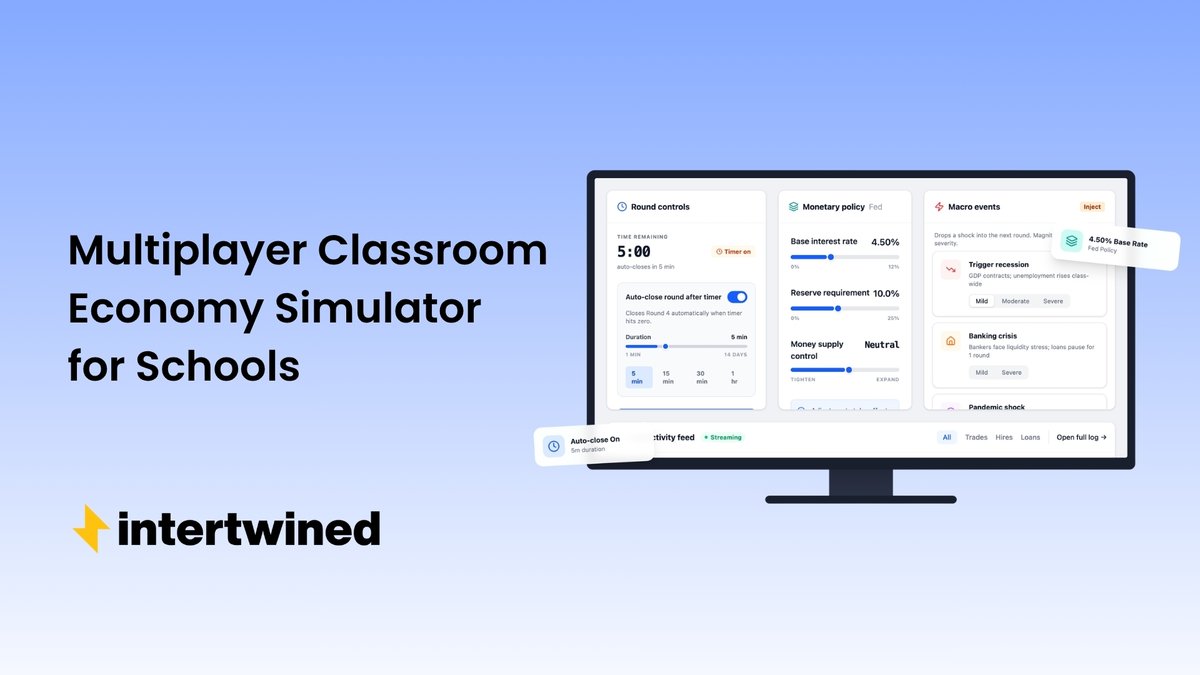
The teacher guides the experience and can introduce historically grounded economic events such as the 2008-style banking crisis, 1970s stagflation, or post-COVID inflation. The result is a classroom where personal finance and economics are not separate subjects but one connected experience that students live through together and remember.
The Economy Simulator
The center of this new curriculum is the Economy Simulator. It gives every classroom its own working economy. Prices, wages, business outcomes, and student financial decisions emerge from the actions of the class. A student does not just hear that inflation affects purchasing power. They feel it when their paycheck no longer stretches as far. They do not just define credit risk. They see what happens when a classmate-banker prices a loan poorly. They do not just learn that policy has tradeoffs. They watch their student government make a decision that helps one group and hurts another.
Personal finance, in context
Personal finance remains the heart of Intertwined. Economics gives students the context that makes personal finance real. Students still learn budgeting, credit, banking, saving, investing, taxes, insurance, entrepreneurship, and everyday financial decision-making. The difference is that those topics now live inside the systems that shape real financial life: labor markets, inflation, interest rates, business cycles, government policy, and risk.
We are not replacing personal finance with economics. We are using economics to make personal finance stick.
Around the Economy Simulator, the rest of Intertwined becomes targeted reinforcement. The Budget Simulator, Stock Market Simulator, Startup Simulator, financial calculators, Arcade games, worksheets, and core curriculum can all still be used individually, but in this model, they connect back to the multiplayer classroom economy as part of one larger learning arc.
When students receive their first paycheck in the Economy Simulator, the Budget Simulator reinforces what to do with it. When students are ready to invest, the Stock Market Simulator gives them a deeper way to practice. When students run businesses, the Startup Simulator helps them understand pricing, competition, and entrepreneurship. Every tool serves the same goal: helping students make sense of financial life through experience.
What this changes for schools
Teachers get back their time. Intertwined packages the experience with round-by-round teacher guides, student worksheets, formative and summative assessments, debrief lesson plans, and standards alignment. A teacher can run a three-week unit with less prep than a single traditional lesson plan.
Students get experience, not just information. They do not simply read about market dynamics. They watch a classmate-landlord raise rent and decide whether to stay, negotiate, or walk away. They do not memorize the Federal Reserve's role. They navigate a recession while their teacher holds rates steady. They do not define regulatory capture from a vocabulary list. They watch a student government accept a lobbying offer and lose public trust.
Administrators get outcomes they can defend. Intertwined is designed to align with state personal finance standards, CEE, Jump$tart, and AP Macroeconomics. It can support a quarter, semester, or full-year course. For districts implementing personal finance graduation requirements — now law in 39 states, up from 17 three years ago — Intertwined gives schools a way to cover the required personal finance content while helping students understand the economic forces behind the financial decisions they will face in adulthood.
What this looks like in practice
A teacher activates the Economy Simulator in first period on a Monday morning. The system loads a 2008 Financial Crisis scenario, assigns student roles, and generates the unit calendar. Round 1 opens that afternoon. Students log in, post listings, accept jobs, make their first financial decisions, and begin building the economy they will live in for the rest of the unit.
Wednesday's class is the Round 1 debrief. The Gini coefficient is already at 0.31. Two students did not get hired. One landlord raised rent faster than wages. The teacher pulls up the auto-generated discussion prompts and the class talks through what happened. Friday's worksheet asks each student to reason through their own decisions, with the math pre-populated from their actual simulation data.
Week 2: the teacher triggers the banking crisis event. The student government has to decide whether to bail out a failing classmate-banker or let the bank collapse. Businesses worry about credit. Renters worry about jobs. Students watch the consequences unfold in real time.
Week 3: the class moves into regulation, recovery, and reflection. The teacher generates the end-of-simulation report, which can support grading, LMS export, and parent-facing communication. Students close the rotation by reflecting on what they did, what changed, what they would do differently, and how the experience connects to their own financial futures.
Week 4: a new rotation of roles begins.
The lesson is no longer abstract. The economy is something the class built, broke, debated, and learned from together.
Where we are, and where this is going
Intertwined already serves 30,000+ students across 200+ school districts. Over the past three years, we have built curriculum, simulations, financial calculators, classroom games, and teacher tools around one belief: students remember what they experience. The Economy Simulator is the clearest expression of that belief.
Last week, I was on a Forbes Under 30 Summit panel with other EdTech founders on the future of simulations and AI in education. The conversation kept returning to one question: how do we move classrooms past static content into experiences students actually live? The Economy Simulator is Intertwined's answer, and the next step in how this subject gets taught.
Intertwined is building the classroom economy that students carry with them long after the course ends.
Pricing
$500 per school per year. Flat. No per-student fees, no per-teacher seats, no premium tier behind a sales call. Full Economy Simulator access, all scenarios, the complete Personal Finance Core Foundations (2e) curriculum and assessment library, and live virtual professional development for every teacher in the building.
Existing Intertwined customers, schools and districts with active contracts, or contracts in active negotiation as of May 1, 2026, receive the Economy Simulator and the new curriculum at no additional cost through the remainder of their term.
For Title I schools, charters, microschools, or rural districts where $500 is a real blocker: email CEO Kerry Ao directly at kerry@intertwinedfinance.com. The company will work it out.
Reserve your school
The Economy Simulator launches July 2026. Reservations are open now at www.intertwinedfinance.com/economy-simulator. Schools that want to see it before reserving can book a demo from the same page.
The classroom is the most underused asset in personal finance education. The Economy Simulator is built to change that.