Top 10 Personal Finance Curriculum Options for High Schools (2026 Guide)
Compare the top 10 personal finance curriculum options for high schools in 2026. See pros, cons, pricing, and efficacy data for Intertwined, NGPF, EVERFI, Ramsey, Banzai, and more.
Financial literacy is no longer optional. More than half of US states now require a standalone personal finance course for high school graduation, and districts everywhere are evaluating which curriculum to adopt. But not all programs are created equal. Some are worksheet libraries, some are video lecture series, and a new generation of platforms teaches money the way students actually learn: by using it.
This guide compares the top 10 personal finance curriculum options for high schools in 2026, with honest pros and cons for each, so curriculum directors, teachers, and administrators can find the right fit.
Quick Comparison
Rank | Program | Model | Price | Best For |
|---|---|---|---|---|
1 | Intertwined | AI simulation-first, gamified | Free & Paid | Districts that want engagement plus measurable mastery |
2 | Next Gen Personal Finance (NGPF) | Curriculum library + PD | Free | Teachers who want ready-made lessons and training |
3 | EVERFI | Sponsored digital courses | Free | Schools that need a no-budget turnkey option |
4 | Ramsey Foundations in Personal Finance | Video-based curriculum | Paid | Classrooms that prefer structured video instruction |
5 | Banzai | Scenario-based online courses | Free (sponsored) | Supplemental real-life practice |
6 | PersonalFinanceLab | Budgeting + stock market game | Paid | Classes centered on semester-long simulations |
7 | Junior Achievement | Experiential + volunteer-led | Free/varies | Hands-on capstone experiences like JA Finance Park |
8 | Knowledge Matters (Virtual Business) | Business/finance simulations | Paid | CTE and business departments |
9 | Take Charge Today | Research-based lesson plans | Free | Educators who want academic, editable materials |
10 | SIFMA Stock Market Game | Investing simulation | Low cost | Investing units and competitions |
1. Intertwined: Best Overall Personal Finance Curriculum
Intertwined is an AI simulation-first, gamified financial literacy platform built for K-12 schools and youth programs. Instead of teaching money through worksheets, Intertwined puts students inside realistic simulations: they trade in a live stock market simulator, build and defend budgets, and even run their own startups. An AI layer adapts the experience to each student, and a full teacher dashboard handles assignments, grading, and analytics.
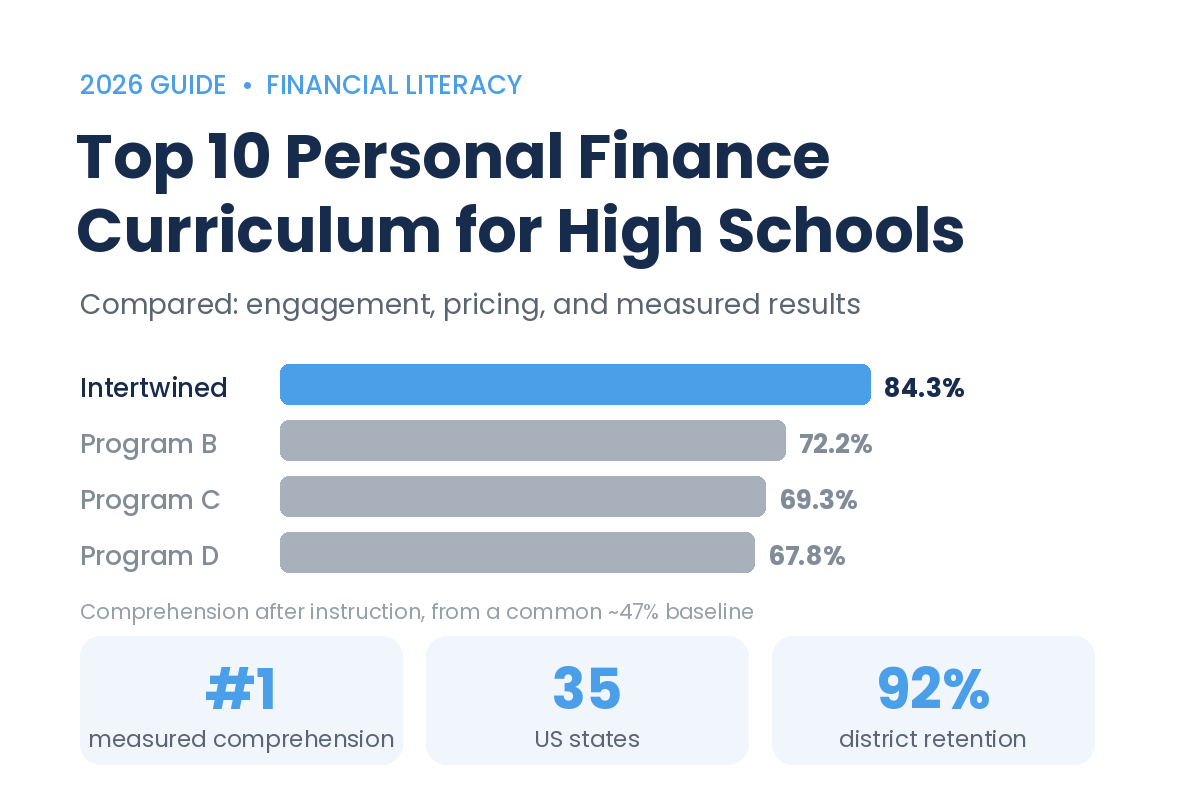
The results stand out. In a 2025-26 efficacy analysis using NGPF's measured ~47% pre-test as a common baseline, Intertwined students finished at 84.3% comprehension, the highest post-instruction score of any major program measured (compare: Banzai at 71.7%, NGPF FLPEA results at 69.3%, Ramsey at 68.9%, EVERFI at 67.8%). Teacher sentiment matches the numbers: 9 in 10 teachers recommend Intertwined to a colleague, 4 in 5 say it saves them time, and 93% describe it as realistic and engaging.
Intertwined is used in 230+ districts across 35 US states and 8 countries, reaching 50,000+ students, including some of the largest districts in the country.
What's included:
Standards-aligned personal finance curriculum (state graduation requirements covered)
Stock Market, Budgeting, and Startup simulations with AI-driven adaptivity
Full LMS with teacher workflow: rosters, assignments, auto-grading
Advanced student data and analytics for teachers and administrators
Multi-stakeholder platform serving schools and youth programs
Freemium model: free Starter tier, per-student pricing for premium
Pros | Cons |
|---|---|
Highest measured comprehension score (84.3%) among major programs | Newer company than legacy providers |
Simulation-first learning students genuinely engage with | Premium simulations require a paid tier |
AI-adaptive lessons personalize pacing and difficulty | Best experience requires 1:1 devices |
Full LMS and analytics reduce teacher workload | |
9/10 teacher recommendation |
Bottom line: If you want students to practice real money decisions and want data proving they learned, Intertwined is the strongest option available in 2026.
2. Next Gen Personal Finance (NGPF)
NGPF is the best-known free curriculum library in the space, offering semester and full-year courses, activity banks, and extensive teacher professional development. Its FLPEA results (2024-25) showed students reaching 69.3% comprehension from a 46.85% pre-test.
Pros | Cons |
|---|---|
Completely free, funded by a nonprofit | Curriculum/worksheet model with fewer immersive simulations |
Massive, frequently updated lesson library | No full LMS; relies on your existing systems |
Excellent teacher PD and certification courses | Less student-facing personalization |
Strong community of educators | Engagement depends heavily on the teacher |
3. EVERFI
EVERFI offers free, sponsor-funded digital courses, including its flagship high school financial literacy course. A 2023-24 MassMutual Foundation study reported a 21-point gain in student confidence.
Pros | Cons |
|---|---|
Free to schools through corporate sponsorship | Sponsored content raises curation questions for some districts |
Turnkey, self-paced modules | Reported outcomes center on confidence, not comprehension |
Easy rostering and reporting | Click-through format can feel passive to students |
Broad course catalog beyond finance | Limited teacher customization |
4. Ramsey Solutions: Foundations in Personal Finance
The Dave Ramsey-branded curriculum is video-driven and widely adopted, with charismatic on-camera instruction and a structured teacher guide. Studies from 2017-21 place post-instruction comprehension around 68.9%.
Pros | Cons |
|---|---|
Polished, engaging video content | Paid license per classroom |
Structured and easy for new teachers | Strongly opinionated philosophy (strict debt aversion) may not match all standards |
Strong parent brand recognition | Lecture-video model offers little hands-on practice |
Minimal analytics |
5. Banzai
Banzai delivers scenario-based online courses where students navigate life events and budget trade-offs, sponsored by local financial institutions. Its published improvement histogram suggests roughly a 24.8-point average gain.
Pros | Cons |
|---|---|
Free through sponsor model | Depth is limited for a full-semester course |
Real-life scenario decision making | Light teacher analytics |
Simple onboarding | Published efficacy data is limited and unspecified in units |
Print and digital options |
6. PersonalFinanceLab
PersonalFinanceLab combines a monthly budgeting game with a stock market simulation, designed to run across a semester.
Pros | Cons |
|---|---|
Genuine game-based budgeting practice | Paid per-student licensing |
Integrated stock market game | Reports a different efficacy metric, hard to compare |
Curriculum library included | Interface feels dated next to newer platforms |
Less AI-driven personalization |
7. Junior Achievement (JA Finance Park & JA Personal Finance)
JA pairs classroom lessons with experiential capstones like JA Finance Park, where students role-play adult budgets, often supported by community volunteers.
Pros | Cons |
|---|---|
Memorable in-person experiential learning | Requires scheduling, travel, or volunteer logistics |
Long-established nonprofit with local chapters | Availability varies by region |
Strong community and employer connections | Digital experience is thinner than dedicated platforms |
Often free to schools | Limited ongoing analytics |
8. Knowledge Matters (Virtual Business: Personal Finance)
Knowledge Matters offers visual, game-like business and personal finance simulations popular in CTE and business departments.
Pros | Cons |
|---|---|
Deep, polished simulations | Paid per-seat licensing |
Strong fit for CTE pathways | Oriented to business courses more than core finance requirements |
Self-grading assessments | Less curriculum breadth for standards coverage |
No adaptive AI layer |
9. Take Charge Today (University of Arizona)
A research-based library of editable lesson plans and activities developed at the University of Arizona, long trusted by family and consumer science educators.
Pros | Cons |
|---|---|
Free, academic, research-grounded | Traditional print/lesson format |
Fully editable materials | No student-facing platform or simulations |
Solid scope and sequence | Requires significant teacher assembly |
Program's long-term support has been in transition |
10. SIFMA Foundation: The Stock Market Game
The classic investing simulation used by millions of students, with teams managing a virtual $100,000 portfolio in a national competition.
Pros | Cons |
|---|---|
Time-tested, competition-driven engagement | Covers investing only, not a full personal finance curriculum |
Low cost | Team-based format can mask individual learning |
Ties to real market data | Minimal instruction included; teachers supply the curriculum |
InvestWrite essay extension |
How to Choose a Personal Finance Curriculum for Your High School
Check your state standards first. More than half of states now require a standalone course. Make sure the program maps to your specific standards, not just national ones.
Prioritize practice over exposure. Research consistently shows students retain financial concepts better when they apply them. Simulation-based programs outperform lecture and worksheet models on comprehension.
Ask for efficacy data. Any vendor should be able to show measured pre/post results, not just satisfaction surveys.
Look at teacher workload. Auto-grading, rostering, and analytics determine whether a program saves time or creates work.
Pilot before you adopt. Freemium options like Intertwined and free libraries like NGPF make it easy to run a one-semester pilot and compare engagement.
Frequently Asked Questions
What is the best personal finance curriculum for high school students? Based on measured comprehension outcomes, Intertwined currently leads with 84.3% post-instruction comprehension from a common ~47% baseline, ahead of NGPF, EVERFI, Ramsey, and Banzai. The best choice for your school also depends on budget, devices, and state standards.
Are there free personal finance curriculums for high schools? Yes. NGPF, EVERFI, Banzai, and Take Charge Today are free, and Intertwined offers a free Starter tier.
How many states require personal finance to graduate? More than half of US states have passed standalone personal finance graduation requirements, and the number continues to grow. Check your state DOE for current rules.
What makes simulation-based financial literacy more effective? Simulations let students make decisions, see consequences, and retry, which builds durable understanding rather than short-term recall. That's the model Intertwined is built on, and it's reflected in its efficacy results.