A Guide for Educators

Simulation-Based Financial Education: A Complete Guide for Educators

What it is, how it differs from games and gamification, what a class period looks like, and how to see what students decided

  1. A Decision
  2. A Consequence
  3. A Debrief
  4. Another Try

What Simulation-Based Financial Education Is

Students make financial decisions inside a model of the real thing, and the model answers back

Simulation-based financial education teaches money by having students make the decisions themselves. A simulation is a working model of something real: a household budget, a stock market, a small business, a whole economy. A student makes a choice inside that model, the model applies its rules, and the student sees what follows. Then they choose again.

That is the difference from reading about a budget or filling in a worksheet. A worksheet has one right answer and ends when it is handed in. A simulation has trade-offs, and its results carry forward: rent chosen in one month is still due the next, and a savings habit started early is there when something goes wrong.

The method is one kind of experiential learning, the broader idea that people learn by doing something and then thinking about what happened. In a classroom the simulation supplies the doing. The teacher supplies the thinking: the questions before a run, the pause in the middle of it, and the debrief after.

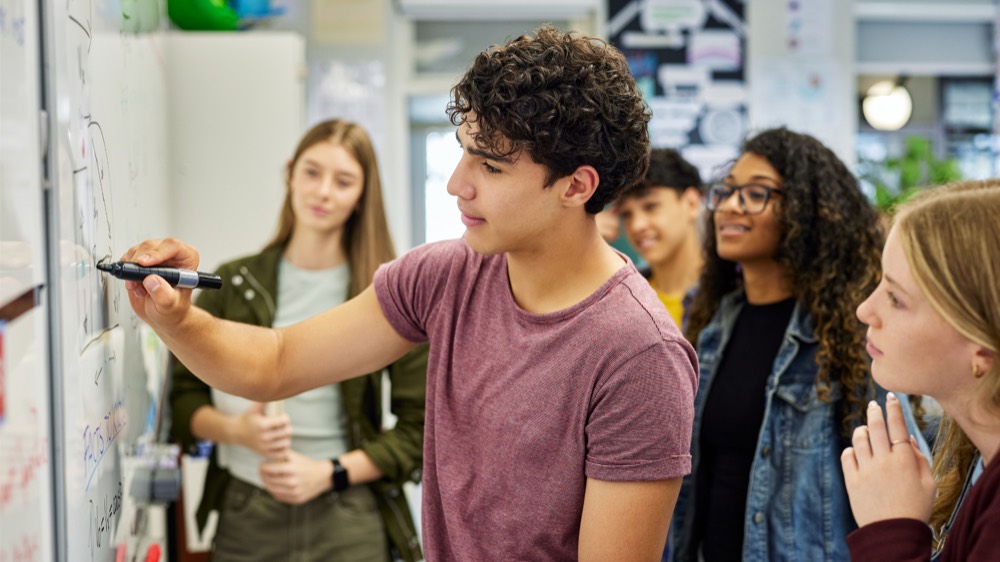
A student writing on a whiteboard while classmates look on
A Choice to MakeMore than one good answer
A Result to ExplainThe debrief comes after

Four Things Every Classroom Simulation Has

  • A model with rules: prices, pay, interest, and the events that follow from them
  • Decisions that belong to the student, with more than one defensible answer
  • Consequences that arrive later and carry forward
  • Time set aside to talk about what happened

What Published Sources Say, and What They Do Not

Two sources we have read, each with its limit beside it, and the claim this guide does not make

Consumer Financial Protection Bureau, 2016

The CFPB Recommends Learning From Experience

The Bureau named four strategies for helping young people become financially capable, and one is to give children and youth opportunities to learn from experience. It says its research indicates that effective ones support independent decision-making with guidance and reflection, use teachable moments, allow repeated practice, and include planning and goal setting.

A recommendation, not a measured result for any product or classroom

Read the CFPB's Four Strategies
Review of Educational Research, 2020

Simulations Help College Learners Build Complex Skills

A meta-analysis by Chernikova and colleagues pooled 145 studies of simulation-based learning in higher education, in fields such as medical education, teacher education, and management. It found a large positive overall effect on learning complex skills, and that learners with less prior knowledge did better when they were supported by examples.

Its learners were in higher education. It is not a study of K-12 financial education

Read the Meta-Analysis
This guide

What We Do Not Claim

We have not found a study that settles whether simulations raise test scores or change money habits for K-12 students in general, so this guide describes the practice and makes no such claim. Intertwined reports its own quiz accuracy for the 2025-26 school year on its Results page. That is a platform figure, not a study of simulations.

No outcome statistic appears anywhere in this guide

See the Results Page

Sources last opened in November 2026. The CFPB page is marked by the Bureau as archived content

Simulation, Game, and Gamification: How They Differ

Three words that get used as one, and the different question each puts to a student

A Simulation Models a System

It copies how something real works, with its rules and its consequences. There may be no winner at all.

The Question It AsksWhat happens if?

For Example: A student picks an apartment, and the rent comes out of checking every month after

A Game Adds Rules and a Way to Win

A goal, a score or a finish line, and limits on how to get there. A game can sit on top of a simulation, or have no model under it.

The Question It AsksHow do I win?

For Example: A class ranking by portfolio value turns a market simulation into a competition

Gamification Adds Points to Ordinary Work

Points, badges, streaks, and leaderboards attached to a task that is not a game. The task itself does not change.

The Question It AsksWhat do I get?

For Example: A badge for finishing five worksheets

A 2011 paper by Deterding, Dixon, Khaled, and Nacke defines gamification as "the use of game design elements in non-game contexts". The three overlap, and most classroom tools mix them. A class ranking is a game element sitting on top of a simulation.

A useful test: take away the points and the ranking, and ask what is left. If a model with decisions and consequences is still there, it is a simulation. If only the worksheet is left, it was gamification.

None of this makes games or points bad. A short game is a fine way to practice one idea in a single period, and the Arcade has 16+ of them, 15 to 30 minutes each, with worksheets. The point is to know which of the three you are assigning, because each one teaches something different.

Simulation-Native Curriculum

Decisions built into the coursework, so that doing the coursework is what moves the simulation

Most simulations are an activity beside the course. We use simulation-native to mean a course in which the simulation is not a separate assignment. The decisions sit inside the lessons, so what a lesson teaches is what the next decision needs, and there is nothing extra to log in to or to assign.

Twine Town is the example on this site. It is the town a student builds while taking Personal Finance Core Foundations (3e), the free course. It is on by default, with nothing to set up.

Aligned to the Jump$tart Coalition and Council for Economic Education (CEE) national standards

  • Every Finished Section Is a Paid ShiftA payday lands every two sections, and bills come due every four
  • The Pay Is Theirs to ManageFour places to live, the bus or a used car, fun money, and savings, each with a monthly cost
  • Lessons Open New ChoicesAutomatic savings opens after section 5.4, and the Insurance office after 9.1
  • Earlier Choices Come BackIn Unit 9 something goes wrong, and the bill is set against what the student saved and the coverage they picked
See Twine Town

Twine Town is free with the course on every plan, and it is not one of the six simulators · See the Course

From the Simulator Pages

What a Simulation Looks Like in a Class Period

The simulators differ, but a run in class follows the same four moves

  1. Before ClassPreview It as a StudentStep through the simulator on sample data before your class does, and pick a pacing guide
  2. Setting UpSet the Rules and Assign ItA difficulty for the Budget Simulator, a starting balance for the Stock Market, one of five eras for the Economy, a country for Global Trade
  3. During ClassStudents Decide, You Set the PaceIn the Economy Simulator you advance each round by hand, and in the Business Simulator you run each day for the whole class with one button
  4. After the RunDebrief With What HappenedThe Economy Simulator's final report, the café's books, or a score against history give the class something to explain

Pacing guides cover the course and every simulator · See For Teachers

Four students smiling together at a classroom table
Pause the ClassThen ask why

Plan the Debrief Before the Run

A simulation gives students something to explain. The explaining happens in the conversation after it

Decide before class where you will stop and what you will ask. Three questions work for any simulation, in this order. They are our suggestion, written for this guide.

  1. What did you decide, and what did you expect to happen?Gets the reasoning on the table before the result colors it
  2. What happened instead, and what in the model caused it?Sends students back to the rules: the interest, the bill, the price
  3. What would you do differently, and which lesson explains why?Ties the run to the course, so it is more than a good or bad score

Six Kinds of Financial Simulation

Each models a different system, so each one teaches a different set of decisions

The six simulators come with a school plan, with a 14-day trial on Teacher Solo. Twine Town is built into the free course and is not counted among them · See Pricing

Classroom Economies and Financial Decision-Making

When classmates set the prices, every decision has a person on the other side of it

A classroom economy is a simulation in which the class itself is the system. Students hold roles and deal with each other, so a price is something a classmate chose and can be argued with. What it adds to a simulation a student plays alone is interdependence: one student's rent is another's income, and one student's loan is another's payroll.

  • Six RolesRenter, landlord, business owner, banker, finance minister, and regulator
  • Prices Set by ClassmatesStudents rent from a classmate at the rent they set, and work for the wage a classmate pays
  • The Teacher Is the FedYou set the interest rate, trigger macro events, and advance each round by hand
  • A Report to DebriefInequality, rent, wages, prices, and unemployment, plotted across every round the class played
See the Economy Simulator

The Economy Simulator comes with school plans from Core · See Pricing

Where the Behavioral Economics Unit Fits

A simulation gives students decisions of their own to examine

Unit 11 of Personal Finance Core Foundations (3e) is Behavioral Economics: nine lessons on the psychological biases that shape everyday money decisions. The unit stands on its own. Taught after a simulation, each idea has a choice the student made to be tested against, and the questions here are ones a teacher could ask.

A student smiling with a pencil in hand at a classroom desk
Unit 11Rational vs. real decisions
  • Lesson 11.3Loss Aversion and RiskDid you hold a falling stock because selling would make the loss real?
  • Lesson 11.4Anchoring and FramingDid the first rent you saw decide what felt like a fair price?
  • Lesson 11.5Mental AccountingDid you treat a quiz bonus differently from a paycheck?
  • Lesson 11.6Present Bias and Delayed GratificationDid fun money this month beat savings for later?
  • Lesson 11.7Social Proof and Herd BehaviorDid you buy something because the rest of the class did?

The lesson names are the course's own. The questions are suggestions written for this guide · See Unit 11

How a Teacher Sees What Students Decided and Learned

Each simulator keeps a record of the choices, so the debrief starts from what students did

  • Financial HabitsWhat students chose in the simulators, grouped by habit and tied to the section that teaches it
  • Open Any StudentIn the Budget Simulator: their balances, the phases they passed, and the choice they made at every life event
  • A Reason on Every OrderStock Market orders carry the student's written reason, to tell a good call from a lucky one later
  • A Class View With No NamesTwine Town counts what the class chose and shows it full screen for discussion, with no names on it
  • Reports and DownloadsThe Economy Simulator's final report, the Business Simulator's class results in Excel, and Global Trade's class view as CSV or Excel

What students learned in the course shows up beside it. Every quiz score fills the Gradebook by student and section, and Reteach ranks the topics the class missed most.

Analytics, the Gradebook, and Reports are on Teacher Solo and school plans · See For Teachers

Five students talking as they walk down a school hallway

Questions About Teaching With Simulations

What Is Simulation-Based Financial Education?
Teaching personal finance and economics by having students make decisions inside a working model, such as a budget, a market, or a class economy, and then talking through what followed
Is a Simulation the Same as a Game?
No. A simulation models a system and its consequences. A game adds rules and a way to win, and gamification adds points and badges to ordinary work
What Is a Simulation-Native Curriculum?
A course with the decisions built into the coursework. In Twine Town, every finished section of the free course is a paid shift, and the pay is the student's to manage
What Does the Research Say?
The CFPB recommends giving young people chances to learn from experience, and a 2020 meta-analysis found simulations effective for complex skills in higher education. We know of no study that settles it for K-12 financial education, and we do not claim one
How Much Class Time Does a Simulation Take?
It depends on the simulator. The Budget Simulator's pacing guides run 5, 10, or 20 class days, a Business Simulator run is 5, 10, 15, or 20 days, and the Stock Market Simulator runs from a week to a full year
Do I Need a Paid Plan to Start?
No. The course and Twine Town are free on every plan. The six simulators come with school plans from Core, at $7 per student per year, with a 14-day trial on Teacher Solo
Can I Grade a Simulation?
Parts of it. A Twine Town checkpoint and the Business Simulator both suggest scores in the Gradebook, while Global Trade's class patterns are for discussion and not a grade
What Do Classmates See of Each Other?
Twine Town's leaderboard shows a first name, a last initial, and a quality of life score. The Budget Simulator's Neighborhood shows a place and a first name, never a balance

For plans and prices, see Pricing

Start With the Free Course and Twine Town

Teach a unit, watch what students choose, and add a simulator when the class is ready for one

No credit card required · See Pricing